


 русский
 Français
 Español
 Indonesia
 عربى
عربى



You've received samples from three suppliers. Two of them look similar in photos. In person, one feels noticeably different — the grain pattern has a slightly plastic flatness to it, the color shifts under different light, and the edge trim doesn't quite match the face. The other sample has a warmth and depth that photographs can't capture. Identifying what separates them isn't always intuitive, especially when you're evaluating at volume or working remotely with a China Interior Door supplier across a significant distance. Veneer Interior Door quality is real and measurable — but only if you know what to look for and what questions to ask before a container ships.
Evaluation ChallengeWhy Wood Grain Quality Is Harder to Evaluate Than It Looks
A convincing wood grain surface and a genuinely high-quality one can appear nearly identical in product photography. The gap between them shows up over time: adhesion failure at the edges, inconsistent color across a batch of doors, surface finish that wears unevenly after a year of use.
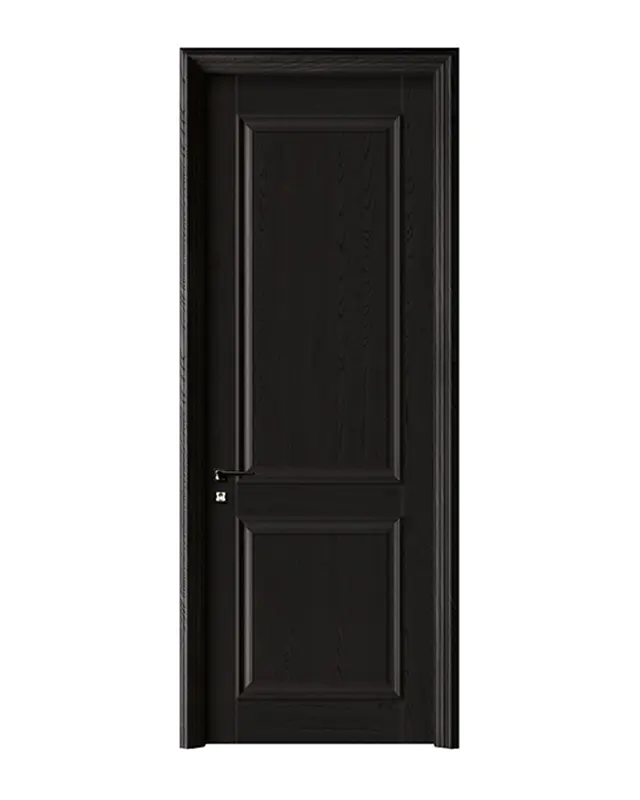
The challenge for buyers is that veneer and wood grain finish products span a wide quality range within the same general category. A door described as "real wood veneer" can mean a thick, premium-grade slice of natural wood bonded with precision — or a thin, inconsistent sheet applied under low pressure with cost-optimized adhesive. Interior door material comparison only produces useful results when the evaluation criteria go beyond surface appearance.
Understanding what actually differentiates quality at each level of the product — substrate, veneer, adhesion, finishing — gives buyers a framework that holds up across different suppliers, different product lines, and different sourcing contexts.
SubstrateThe Substrate: Where Quality Starts Before the Surface
The visual surface gets most of the attention, but the substrate underneath determines how the finished door performs over its full service life. Veneer and surface treatments are only as stable as the core they're bonded to.
Substrate types commonly used in interior doors:
- Solid wood: Genuine timber core, dimensionally stable in controlled environments but susceptible to movement with humidity change. Used in premium residential and hospitality applications.
- Engineered wood composites (HDF/MDF): High-density or medium-density fiberboard provides a flat, dimensionally consistent surface for veneer application. Density and uniformity of the board directly affect how well the veneer adheres and how resistant the door is to denting or surface deformation.
- LVL (Laminated Veneer Lumber) core: Cross-laminated engineered core used in structural door frames for dimensional stability and screw-holding strength.
- Hollow core: Internal honeycomb or block structure with face skins, used in lightweight interior doors where sound and thermal performance aren't primary requirements.
Surface TypesNatural Veneer vs Engineered Wood Grain: Understanding the Difference
The terminology in this product category is inconsistent across markets. "Wood grain" can describe genuinely natural veneer, paper-foil printing, PVC film with an embossed texture, or any combination of these with different marketing language applied. Clarifying which type of surface finish is being specified is the starting point for any meaningful quality evaluation.
Natural Wood Veneer
Sliced or peeled from real timber logs. The grain pattern is genuine and varies naturally between sheets. Color, texture, and figure are inherent to the wood species selected. Requires skill in matching adjacent panels for consistent appearance across a door set.
Reconstituted Veneer
Engineered from wood fibers or thin slices recomposed to produce controlled, repeatable grain patterns. More consistent across batches than natural veneer but lacks the natural variation that gives high-end products their visual warmth.
Melamine Paper / HPL
A printed paper or composite surface bonded under heat and pressure. Available in a wide range of grain patterns and colors. The visual fidelity of printed grain has improved considerably, but the tactile quality remains distinguishable from real wood texture.
PVC / Foil Wrap
Thermoplastic film, often textured with an embossed grain pattern. Used in lower price point products. The surface has characteristic visual traits — a slight sheen, a uniformity of texture that doesn't occur in real wood — that experienced buyers identify quickly.
Sample AssessmentHow to Evaluate Veneer Quality: A Practical Assessment
When physical samples are available, a systematic evaluation covers several distinct dimensions.
Material ComparisonInterior Door Material Comparison: Which Surface Finish for Which Application?
| Surface Type | Visual Quality | Durability | Suitable Applications |
| Natural wood veneer | High — natural variation and depth | Moderate — needs proper finishing | Premium residential, hospitality |
| Reconstituted veneer | Good — controlled pattern | Good | Mid-range residential, commercial |
| High-pressure laminate | Good — improved print fidelity | High — scratch resistant | Commercial, high-traffic interior |
| Melamine paper finish | Moderate — dependent on print quality | Moderate | Volume residential, budget commercial |
| PVC / foil wrap | Lower — limited visual depth | Lower — surface prone to peeling | Entry-level, price-sensitive |
Production ProcessWhat Does High-Quality Veneer Production Actually Involve?
Understanding the manufacturing process that produces high-quality veneer doors helps buyers evaluate supplier claims more accurately.
Veneer Slicing & Grading
Natural veneer is graded by grain consistency, figure, and defect presence. Premium grades select for minimal knots, consistent grain flow, and appropriate figure for the species. Lower grades accept more variation and visible defects.
Moisture Content Control
Veneer applied to substrate at incorrect moisture content will move differently from the substrate as humidity changes, causing eventual delamination. Controlled drying and acclimatization before bonding is a quality indicator.
Adhesive Selection
The adhesive used in veneer bonding affects both immediate adhesion strength and long-term stability. Environmental certification is also relevant — low-formaldehyde or formaldehyde-free adhesives are increasingly required in residential and hospitality projects.
Press Conditions & Finishing
Temperature, pressure, and dwell time in the press determine the quality of the bond. Multiple sanding passes between finishing coats produce a smoother, more consistent final surface — cutting corners here is one of the ways production cost is reduced at the expense of quality.
Supplier EvaluationEvaluating Interior Door Wholesale Suppliers: Beyond the Sample
A good sample is necessary but not sufficient. The sample represents what a supplier can produce when motivated to impress. Volume production represents what they actually produce consistently.
Supplier evaluation criteria beyond sample quality:
China Supplier PositioningHow China Interior Door Suppliers Are Positioned for Volume Procurement
China remains a significant source for interior door procurement at volume, particularly for mid-range to premium veneer products destined for residential development, hospitality, and commercial fit-out projects internationally.
The quality range within China Interior Door production is wide. Manufacturers at the higher end invest in modern pressing equipment, consistent raw material sourcing, finishing lines capable of high-quality coat application, and quality management systems that track production through batch records. At the lower end, cost pressure drives material substitution and process shortcuts that show up in finished product performance.
For buyers sourcing at volume, the practical differentiation is factory audit and verified references rather than product categories or price points alone. A supplier producing Veneer Interior Doors at a moderate price point with strong process controls and documented quality management often delivers more consistent value than a premium-priced supplier without the same infrastructure.
Long-Term PerformanceEvaluating Quality That Holds Up Over Time
Evaluating wood grain and veneer quality in interior doors is a skill that develops through systematic attention to the right details — substrate consistency, adhesion quality, grain realism, surface finish uniformity, and the production discipline behind all of them. The gap between a door that passes initial inspection and one that holds up across five years of use and three climate cycles is largely invisible at the sample stage and entirely predictable from the manufacturing process. Buyers who invest in supplier qualification upfront — factory documentation, process review, reference checks, and multi-sample batch evaluation — avoid the replacement costs and project disruptions that inconsistent product creates downstream.
If your project involves sourcing Veneer Interior Door products at volume, Zhejiang Haibo Door Co., Ltd. produces veneer and wood grain interior doors for residential, commercial, and hospitality applications, with documentation support for international procurement including material sourcing, environmental compliance, and production batch records. Bringing your specification, volume, and project timeline to that conversation is the direct way to assess fit before commitment.
 Previous


