


 русский
 Français
 Español
 Indonesia
 عربى




Before you place an order, get five things clear with the supplier: your project background, which parts can be customized, what the quotation covers, how production and delivery will be scheduled, and who handles communication. Keep the approved drawings, order details, and written confirmations together in one folder. This saves time for both sides.
Finding a supplier that can make HPL doors is only the starting point of a purchase. Many of the delays buyers run into have little to do with the product itself. They come from a missed detail in the inquiry, a drawing that was updated but not re-sent, or a delivery date that two people understood differently.
Does the Factory Really Understand What Your Project Needs?
A supplier can only respond well to what it has been told. Before you send an inquiry, it helps to spend some time organizing the background of your project. Think of it as writing a short brief rather than a shopping list.
Where Will These Doors Actually Be Installed?
Start with the building type. A residential apartment block, a hotel, an office building, and a school all place different demands on a door. When the factory knows the setting, it can ask better questions and suggest options that fit.
- Say whether the project is residential, hospitality, commercial, or something else.
- Describe the overall design direction, such as modern, minimal, or traditional.
- Explain whether you need a standard catalog product or a door made to suit a particular project.
Even two or three sentences about the project can change the quality of the reply you receive.
Which Requests Are Fixed and Which Can Flex?
Not every requirement carries the same weight. Some are fixed because of building plans or client approval. Others are preferences that could shift if there is a good reason.
- Separate the items that must be met from the details that can be adjusted.
- State sizes, colors, opening directions, and related requirements at the outset.
- Try not to add new conditions after the quotation has started.
When requirements keep growing during the inquiry stage, the price and the production plan often need to be redone. A clear list from the beginning keeps the conversation moving in one direction.
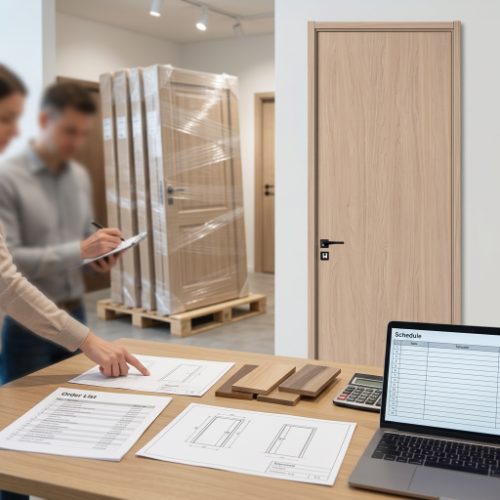
Can the Factory Handle Custom Orders Without Surprises?
Customization is where many projects either run smoothly or slow down. The word covers a lot of ground, so it is worth being specific about what you are asking for.
What Exactly Can Be Changed?
Different factories support different kinds of changes. Some are comfortable adjusting sizes. Others can also work with special design details or project-specific color requests. Ask directly rather than assuming.
- Find out which areas of the door the factory is able to customize.
- Ask whether a custom request will change the production arrangement.
- Do not assume every design change can be made as a simple edit.
A good question to ask is, "If we change this detail, what else will it affect?" The answer often shows how well the team understands its own process.
Who Draws, Who Checks, and Who Signs Off?
Drawings are the shared language between buyer and supplier. If nobody is sure who owns them, errors can slip through.
- Decide who will provide the drawings and design files.
- Agree on how sizes, opening directions, and similar details will be reviewed.
- Confirm one final approved version before production begins.
- Make sure older files are clearly marked as replaced, so they are not used by mistake.
Old versions are a quiet risk. A file that was correct last month may no longer match the current plan, yet it can still be sitting in someone's inbox.
What Should a Quotation Actually Tell You?
A price on its own is not very informative. What matters is what sits behind it. Two quotations can look far apart simply because they cover different things.
Is Everything You Expect Listed in the Price?
- Check which products and what quantity the quotation refers to.
- Ask whether packaging, hardware, transport, and other charges are included.
- When comparing suppliers, make sure you are comparing the same purchase conditions.
A simple way to do this is to put the offers side by side in a spreadsheet and fill in the same rows for each supplier. Gaps become easy to spot.
What Do the Payment and Order Terms Say?
Terms are less exciting than product details, but they shape the whole working relationship. Read them early, not after the order is placed.
- Understand the payment arrangement and what is needed to confirm an order.
- Check how long the quotation remains valid.
- Ask how changes and cancellations are handled, and whether any charges apply.
Material and project conditions can shift over time, so a quotation that is not time-limited may not stay the same. Clarity on this point protects both parties.
How Will Production and Delivery Be Planned?
Once an order is confirmed, the conversation moves from what to make to when it will arrive. This is where project managers feel the pressure, because door delivery often depends on the pace of construction.
What Happens Between Confirmation and Shipment?
Production is more than the time spent making the door. Several steps sit around it, and each one takes time.
- Ask how the factory arranges orders in its production plan.
- Find out whether custom orders need extra preparation.
- Confirm whether the schedule includes drawing approval, material preparation, and packing.
If the schedule only shows a single production period, ask for a breakdown. It is easier to manage a plan when you can see its parts.
Why Should You Talk About Delivery Dates So Early?
An expected completion date and an expected arrival date are not the same thing. Transport, loading, and customs steps sit between them.
- Separate the date production is expected to finish from the date goods should reach the site.
- Discuss receiving arrangements at the project location in advance, such as unloading and storage.
- If delivery is tied to the building schedule, name the key dates clearly.
It is also worth asking what the plan will be if the site is not ready on the day the goods arrive. A short conversation now can prevent a storage problem later.
Who Is Your Point of Contact When Things Get Busy?
On a live project, questions arrive from many directions: price, design, production, shipping. If it is unclear who answers what, messages get lost.
How Should the Conversation Be Organized?
- Confirm who handles purchasing, design, production, and logistics questions on each side.
- Agree on the everyday communication channel and how important files will be shared.
- Keep written confirmation for any change affecting price, design, or timing.
Verbal agreements are convenient, but they are hard to check later. A brief email that restates what was agreed takes a minute and can save a long discussion.
What Is the Plan When Something Changes?
Changes happen on almost every project. The goal is not to avoid them completely but to handle them in an orderly way.
- Agree on whether changes are allowed once the order is confirmed.
- Talk through how a change might affect cost and delivery time.
- Proceed only after both sides have agreed.
Which Documents Should Be Ready Before Production Begins?
Paperwork rarely makes anyone excited, yet a tidy document set is one of the simplest ways to keep an order on track. Gather these items before the factory starts work, and keep copies on your side as well.
| Document | Why it is useful | Who usually provides it |
|---|---|---|
| Final product specification and order list | Shows exactly what is being made and in what quantity | Buyer and factory together |
| Approved drawings and design files | Gives both sides the same reference for sizes and details | Buyer or designer, confirmed by factory |
| Written record of color or design choices | Avoids confusion over names and descriptions | Buyer, confirmed by factory |
| Packing, labeling, and transport requirements | Helps goods arrive organized and easy to identify on site | Buyer, with factory input |
| Purchase order, payment terms, and delivery plan | Sets out the commercial agreement in one place | Buyer and factory |
You do not need a heavy filing system. A shared folder with clear file names, plus a short list of what has been approved, is enough for many projects.
Thinking About a Second Order? What Should You Keep on File?
Many buyers return to the same supplier. Repeat orders go more smoothly when the earlier one is well documented, though they still deserve a fresh check.
What Records Are Worth Saving?
- Keep product codes, drawing versions, and past order details.
- Note any special requirements that both sides agreed to.
- Before adding to an order, confirm whether any product information has been updated.
What Should You Review Before Ordering Again?
- Confirm the original product is still being made to the same requirements.
- Check whether your quantity, project needs, or delivery address have changed.
- Avoid reusing an old quotation or assuming an earlier delivery time still applies.
Treat each repeat order as a small new project that happens to have good records behind it.
What Makes a Supplier Relationship Work?
When you choose an HPL Door Factory, the product is only one part of the decision. How well the team understands your needs, handles custom requests, explains its quotation, plans production, communicates during the order, and organizes documents all shape how the project feels from start to finish.
Before you send your next inquiry, prepare a short project brief, a list of fixed and flexible requirements, and the drawings you already have. With that in hand, the conversation about products and cooperation becomes more specific and more productive.
 Previous


